

Orano's reflections for British Science Week: how can we turn a love of experiments into an interest in nuclear careers?
It’s British Science Week, a ten-day celebration of all things science taking place up and down the country. It’s a big opportunity for the nuclear sector to shout about what it does and the exciting opportunities there are for people to join its ranks.
Since the beginning of the year, Orano has been supporting a series of virtual primary school sessions across Cumbria*, and so a few of our team were lucky enough to take part in a British Science Week session at Lowca Community School. For anyone who’s volunteered in this way, it’s always so rewarding to see the level of enthusiasm primary school students have for learning, and for asking questions of all shapes and sizes to quiz the people they’re talking to. What’s more, let’s face it, the vast majority of these kids are not scared to say what they think. So, to test the water for British Science Week, we asked the question – what’s your favourite thing about science? The resounding consensus was EXPERIMENTS.
For the nuclear sector, the word ‘experiment’ is not necessarily our favourite; it suggests too much ‘trial and error’ for an industry based on demonstrating outstanding levels of safety and predictability. However, it doesn’t mean to say that we can’t channel the energy and curiosity that underpins a love of experiments into how we communicate about careers in nuclear. Just imagine if we could harness the enthusiasm in primary school classrooms such as these to really shift the dial on the number of people entering the nuclear sector.
Here are a few of our reflections this British Science Week.
‘What if’ careers
At the heart of any experiment is the thought, ‘what if?’. It’s the excitement that fascinating things could happen, the sense of agency to change outcomes. That excitement is something nuclear careers can deliver on. What if, as a nuclear professional, I could help to tackle climate change? What if, as an engineer, I could make nuclear processes better for future generations? What if, as a nuclear communicator, I could change public perception in a way that will transform new nuclear deployment? What if I could change the world? In nuclear we have all this at our fingertips. Nuclear professionals really are, and will continue to be, agents of change for the planet and our society, and that’s exciting.
Putting the spark in innovation and R&D
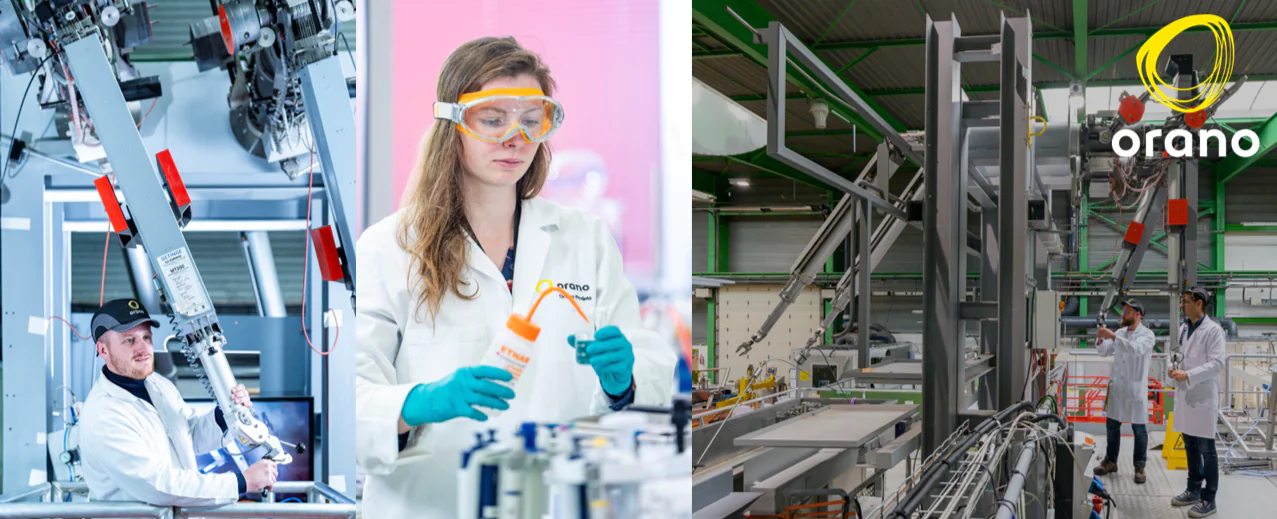
In the nuclear sector, arguably the closest terms we have to ‘experimenting’ are innovation and Research and Development (R&D). We talk a lot about the need to bring together diverse people, experiences, and ideas, to develop new, ground-breaking solutions, but do we communicate enough about the appetite for nuclear innovation and research to people looking to pursue a career in nuclear? If we want today’s primary school pupils to become tomorrow’s nuclear professionals, we need to shout louder about how the sector is a hotbed of pioneering innovations and research. Like many owner-operators of nuclear sites, innovation is a critical part of our mission at Orano; we have large-scale facilities at our site at La Hague, for example, which are dedicated solely to research and innovation. Today we’re delivering the value of that expertise to clients in the UK to support major Nuclear Decommissioning Authority and UK National Nuclear Laboratory programmes. Do we communicate enough about innovation when we speak to people about careers at Orano? Possibly not. Nuclear careers are not all about following tried-and-tested processes; they need imagination, creativity and people inspired to explore. Some of our best nuclear innovators and researchers may well have been primary school pupils with a love of experiments.
Creating experiments
Finally, perhaps the simplest reflection of all. When it comes to inspiring the next generation, let’s respond to the enthusiasm for hands-on experience. Nuclear is often thought about in the abstract but encouraging students to engage with a mock up glovebox, a remote grabbing tool, or a model robotic arm, enables us to bring our sector to life. We’re proud to participate in a number of career events across the country, where alongside other nuclear businesses, we are opting more and more for interactive demonstrations to engage with school students. Engagement skyrockets and suddenly working in nuclear is not that abstract after all.
When it comes to communicating about nuclear careers, let’s experiment!
When we communicate about nuclear careers, we can afford to experiment. If there’s one thing we’ve learnt from British Science Week, it’s to harness people’s enthusiasm to roll up their sleeves. Let’s promote careers that are tangible- where people feel they can instigate change and use their energy and curiosity to drive innovation. If we need to experiment with different ways to communicate that, then let’s get stuck in!
*We would like to thank the Centre For Leadership Performance for supporting us to deliver a series of virtual primary school engagements, as part of their Primary Business Partnership programme, across Cumbria, and the teachers and pupils at Lowca Community School for welcoming us to their British Science Week session.
Orano is an international leading operator in the field of nuclear materials, delivering work in the UK and around the globe.
Images from Orano’s Beaumont Research Hall, La Hague. © Orano, CRESPEAU Cyril, HELSLY Cedric
Back to the hub