The Nuclear Industry Association welcomes the opportunity to respond to the Scottish Government’s draft Climate Change Plan consultation.
The NIA is the trade association and representative body for the civil nuclear industry in the UK. We represent more than 320 companies operating across all aspects of the nuclear fuel cycle, including the current and prospective operators of nuclear power stations, international designers, and vendors of nuclear power stations, and those engaged in decommissioning, waste management and nuclear liabilities management. Members also include nuclear equipment suppliers, engineering and construction firms, nuclear research organisations, and legal, financial and consultancy companies.
Executive summary
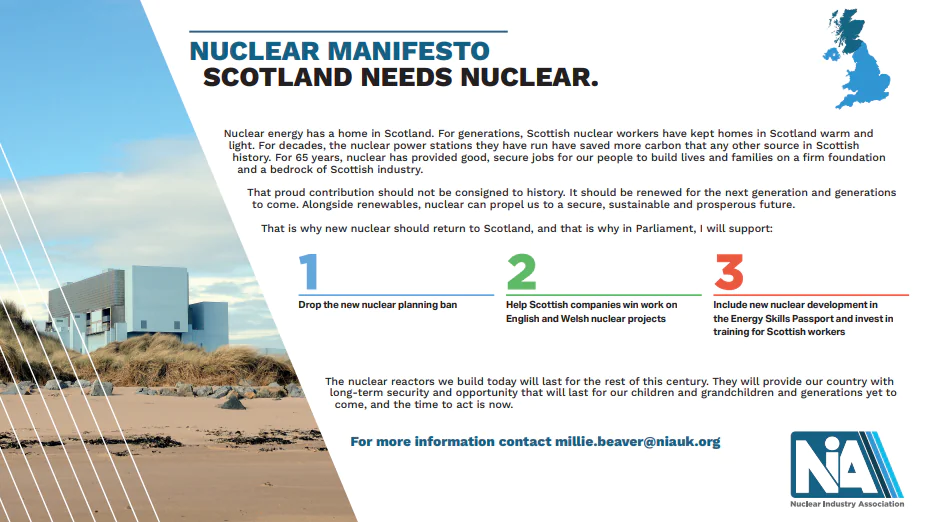
The Scottish Government’s calculated omission of nuclear power, which has saved more carbon emissions than any other power source in Scottish history, from its climate change plan is a serious error of judgement and jarring insult to the contribution of Scottish nuclear workers to their country.
This omission deliberately ignores the established scientific consensus that nuclear working alongside renewables is required to meet net zero. It also ignores the plain evidence from around the world that a functioning, affordable net zero system cannot be achieved by phasing out nuclear power. The plan should be withdrawn and redrafted to reflect the reality of operating a sustainable electricity system and the contribution of the Scottish nuclear workforce.
Torness and Hunterston nuclear power stations are the most productive clean energy assets in Scottish history. Since coming online in 1988, Torness has generated 307 TWh of clean electricity, helping to avoid at least 101 million tonnes of CO₂ emissions. They have produced enough power for every home in Scotland for 60 years. Torness itself remains the largest, cleanest, and most reliable single generator in all of Scotland.
In 2024, Torness nuclear power station accounted for 17% of Scotland’s electricity generation, and it had the highest load factor in Scotland at 75%.
Moreover, nuclear has the lowest impact on the environment of any electricity source. The United Nations has found that it has the lowest lifecycle carbon intensity, lowest impact on ecosystem, and lowest land use of any electricity source. Torness bears this out. The station is the nation’s best generator and takes up just one-tenth of a square mile. According to A. Shepherd et al., compared to nuclear, it takes 354 times more land to produce the same amount of energy from onshore wind in Scotland.
Alongside the environmental benefits, nuclear continues to provide high-quality, well-paying jobs to Scottish communities that need them the most, with 36.4% of direct employment in the civil nuclear sector occurring in the most deprived 25% of Scottish local authorities. Scotland also needs more baseload power — with increasing reliance on variable generation from renewables, constraints payments soared to £1.21 billion in 2025, putting a strain on domestic and industrial consumers. We therefore strongly encourage the Scottish Government to enable the deployment of new nuclear in Scotland, to ensure that decarbonisation objectives can be met with strong economic growth and energy security for Scottish communities.
Please click here to view our response.
Further Information
The NIA is happy to provide more context, or any clarifications desired on the content of our response and to ask our members where appropriate for additional information that may be useful.
Please contact Elisabeth Roden, Policy Analyst for the Nuclear Industry Association, at [email protected] to do this.
Back to the hub